


Not enough ratings
The Aether Chronicles

By: Real Brainy Updated just now
Language:
English
 16

16 Chapters: 7
 views: 11
Read
Add to library
 Report
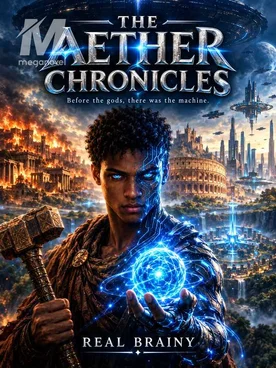
Kaelen Thorne was born a slave in a world ruled by gods and bronze. When he is caught reverse-engineering a fallen "thunder-stone," the priests sentence him to death. But as the executioner's blade falls, the stone awakens—and it knows his name. Now bound to the Aether-Core, a semi-sentient alien nanite mainframe mistaken for divine magic, Kael must flee into a world on the brink of collapse. Hunted by empires, haunted by a voice in his head, and armed with technology three thousand years ahead of its time, he will forge a hidden civilization that secretly guides humanity through every era—from the Bronze Age to the stars. But the Core's original owners are coming back. And they want their machine returned. Before the gods, there was the machine.
Show more
Share


Overview
Catalog
Chapter 1
The Heretic's Stone
The stone was warm.
That was the first thing wrong with it. It sat on a bronze tray at the priest-king's elbow, forty paces from where I knelt, and the morning air in Karesh had that bitter edge it gets before the sun clears the walls. Everything in the square was cold. The cobbles were cold. The chains on my wrists were cold. The crowd breathed out little clouds of fog.
And above the stone, the air shivered like it does above a forge.
I noticed, because noticing is what I do. It is also, I was beginning to understand, what I was about to die for.
"Kaelen, son of Tarn, of the smith quarter," said the priest-king, and the crowd went quiet the way a crowd does when it has been taught to. "You are accused of the oldest heresy. You took the fire the gods threw down and claimed it was a thing a man could understand."
I had, in fact, claimed that. Three times, to a priest, a magistrate and a very bored scribe. They had written it down each time. I will say this for the priests of Karesh: they kept excellent records of the things they killed people for.
The block was the same block. I had assumed they would use a new one, or at least scrub it, but the grain of the wood was dark in the same places, and a slow, stupid part of my mind kept insisting that I recognized it. I had been ten years old the last time I stood in this square. My father had knelt where I knelt. He had not looked at the crowd. He had looked at me, and he had shaped one word with his mouth, and I have spent nine years trying to be sure what it was.
He had said the gods were not gods. That was all. He had worked bronze for thirty years and he knew a made thing when he saw one, and he had seen the sky-fire stones the priests worshipped and said, quietly, to the wrong man, that they had seams.
They had.
I knew, because I had found my own. Two winters ago, in a collapsed kiln-pit at the edge of the quarter, a dark lump the size of my fist, humming at a pitch just below hearing. I had carried it home inside my shirt like a stolen egg. I had spent two years on it by lamplight: tapping it against tuned bronze bells to hear what it answered, measuring how it warmed, drawing the fine pattern of its surface over and over until the pattern began to look less like decoration and more like wiring.
I was not worshipping it. I was reverse-engineering it. In Karesh, those are different crimes, and only one of them has a sentence.
"The heretic's idol," said the priest-king, and lifted the stone from its tray with both hands, and I watched the heat shimmer follow it. "The god's own fire, held by a slave's hands, studied like a common ingot. Let it be returned to the god by the blood of the one who dared."
He was a heavy man with soft hands and a voice like honey poured over a wound. His name was Ushar, and the empire that had conquered our city eleven years ago had put him on the throne because he was the sort of man who would hold the leash for them. He turned the stone in his fingers, and for one moment I saw his face as he looked at it.
It was not the face of a man holding a god. It was the face of a man holding a weapon he did not understand and did not intend to give back.
I filed that away. I was fairly sure I would not get to use it.
"Do you have anything to say?" he asked, with the weary generosity of a man who has asked this many times and always gets the same sort of answer.
I looked at the stone in his hands. It was brighter now, a dull ember glow in the seams, and I realized with a cold clarity that it was responding to something. Not him. Not the crowd. It was responding to me, to my pulse, to the proximity of my body, in a way I had measured a hundred times in the dark of my room and never been able to explain.
"Yes," I said. My voice was steadier than I expected. "It isn't a god. It's a machine. The casing is cracked."
Someone in the crowd laughed, short and shocked, and was hit for it.
Ushar smiled at me with great patience. "Gorrim."
The executioner was a broad, silent man whose entire character, as far as I could tell, was that he did not have one. He stepped up beside me and drew the bronze sword from his back.
I am ashamed to say my first thought was professional.
It was a good blade. Nine parts copper to one of tin, I judged from the color, cast and then cold-hammered, with a fuller down the center to lighten it. The edge was a little proud, a little too hard for a weapon that would only ever meet bone and wood, and I thought, quite clearly, I'd have drawn the temper back a touch. That was the last useful opinion I expected to form.
Then the fear arrived, all at once, like cold water poured down my spine. My knees shook against the stone. I thought of my father's mouth shaping that single word. I thought: so this is what he saw. I thought of my mother, dead four winters, and of the forge cooling in the smith quarter with no one to light it, and I wanted very badly to say something clever and found that I had run out of clever things.
Gorrim raised the sword.
The sun cleared the east wall.
The stone in Ushar's hands went white.
I have tried, in the years since, to describe what happened next in terms a person could follow, and I have failed every time. The nearest I can come is this: for an instant the whole square became very still, as though the world had paused to take a breath. I heard the stone's hum rise from below hearing into sound, a clean single tone, perfectly steady. I felt something enter my hands through the chains. It was not heat, and it was not pain. It was the sensation of a door I had never known about swinging open inside my skull.
The blade came down.
I saw it come. I saw it come very slowly, which I should not have been able to do, in a world that had suddenly acquired a fine grid of pale blue lines across everything I looked at. I saw numbers I had no names for crawl along the edge of the bronze. I saw the arc of the sword and the angle of my neck and the exact distance between them, and I did not move, because there was nowhere to move to.
The edge of the sword touched the air above my shoulder.
And came apart.
It did not shatter. It did not melt. It did not fall. The bronze simply stopped being a sword, starting at the edge and running up the blade toward the hilt in a pale, silent wave, like frost reversing on a window. In half a heartbeat Gorrim was standing over me holding a leather-wrapped grip and nothing else, his whole body still committed to the downward stroke. He overbalanced and almost fell on top of me.
The square did not make a sound.
I remember that most clearly. Several thousand people, a market's worth of noise, and not one of them breathed.
The price arrived a moment later, and I will be honest: it was not subtle.
My legs went first. I slumped sideways against the block and my chains clattered, and my nose began to bleed, warm and steady, over my lip and down my chin. My hands were numb to the wrists. My vision swam. The blue grid flickered, steadied, and then a line of pale writing, in no script I had ever seen, slid across the lower edge of the world and rearranged itself into something I could read.
CHARGE: 61%.
I stared at it. I thought, dimly, that I was probably dying after all, and that this was what it looked like.
Behind the writing, at the very edge of hearing, there was something else. A thin sound like static, like breath over a hollow reed, like someone whispering a word in a language that had not been spoken for a very long time. It was only there for a moment. I told myself I had imagined it.
I did not imagine it.
Across the square, Ushar still held the stone, and his lovely face had gone the color of old tallow. The other priests had begun, one by one, to take a step back. Gorrim dropped the hilt. Somewhere in the crowd a woman started to scream, and the sound broke the stillness like a rock through ice, and the whole square began to move at once.
"Kill him," said Ushar, hoarse. "Kill him!"
Six spearmen started across the cobbles toward me.
And a voice that was not a voice, that spoke from nowhere and everywhere and directly inside my head, said, very calmly:
"Kaelen Thorne. Neural pattern confirmed."
I had never been so afraid in my life. I wiped the blood from my mouth with the back of a numb hand.
"Charge is at sixty-one percent," the voice continued. It sounded, absurdly, faintly apologetic. "I recommend that we do not do that again."
The spearmen were thirty paces away. Then twenty.
"I also recommend running."
Expand
Next Chapter
Download

Continue Reading on MegaNovel
Scan the code to download the app
TABLE OF CONTENTS
Comments
No Comments
Latest Chapter
The Aether Chronicles Sea Peoples Invasion
We smelled the harbor of Marat before we saw it.It was not the smell of fish, or tar, or the sour-sweet rot of drying nets, which is what a harbor ought to smell like. It was the smell of burning timber and something underneath it that I did not want to name. Orin knew it at once. I watched his shoulders change, the way a man's shoulders change when he sees an old enemy across a market."Smoke," said Orin. "A lot of it. Wait here."We had been walking for three days. After the vault we had slipped out of Karesh before dawn, the twelve men of Orin's company carrying the fourteen swords I had forged, and Lyra, Dax and I walking beside them with the stolen fragment wrapped in a rag against my chest. Ushar's search had come down on the temple like a hammer. Behind us, somewhere in the hills, I felt sure the spearmen were following. But the fragment's coordinate pulled at me like a hook in a fish, and it pulled south and west, toward the sea.I crouched at the crest of the last ridge and
 Last Updated : 2026-10-23
The Aether Chronicles The First Fragment
We went in through the sewer, because Lyra had already proved it could be done and because nobody could think of anything worse.It was the fourth night after the Drowned Fish. For three days we had planned, argued and drawn the temple in the dust until Orin's men could have walked it blindfolded. Orin took the outer gate with twelve of his best, who were to start a fire in the lime sheds at the third bell and bring half the temple watch running. Lyra would guide us from below, because she could feel the stone through a foot of rock and a hundred years of masonry. Dax would open the doors. I would do whatever it was I was for."What are you for?" Dax had asked cheerfully, the evening before. "I'm not being rude. I'm curious. I do the doors. Lyra does the ears. Orin does the shouting. You do—""The thinking," I said."Oh good. I was worried it would be something useful.""I am noting that," said the voice in my head."Noted," I said aloud, and Dax gave me a very strange look.CHARGE: 7
Last Updated : 2026-10-23The Aether Chronicles The Thief's Memory
"The vault has seven doors," said Orin, "and I can tell you how to open exactly two of them."He had drawn the temple in the dust of the quarry floor with the stub of a burnt stick, a rough square with a smaller square inside it, and he stood over it with the grim patience of a man explaining a defeat he had already suffered once. Lyra crouched on the far side, chin on her knees. I sat with my back to the forge wall, hands blistered and black, trying to remember how many hours I had slept that week. The answer was an uncomfortable number."Eleven years is a long time," said Orin. "The empire has changed the locks. They've doubled the watch. And I was only ever posted on the outer gate. The man who knows the inside of that vault is not me.""Then who is he?" I said.Orin looked at Lyra. Lyra looked at the dust."A thief," she said. "He's called Dax.""Is he any good?""He's the only person who has ever gone into the vault and come out again," said Lyra. "Six years ago. He was caught on
Last Updated : 2026-10-23The Aether Chronicles The Priestess's Lie
By the sixth day, I had made fourteen swords and lost the feeling in two fingers.I do not recommend it as a career. The quarry forge was a squat, stubborn thing built for sharpening picks, with a bellows that wheezed like a dying ox and a flue that fed half its smoke back into your face. We worked it in shifts through the night, so the smoke would be mistaken for the empire's own lime kilns, and I took the longest shifts because there was no one else who could read the metal.That was the thing about the machine. It did not do the work. It told me where the work was going wrong."Blade nine contains a void near the tang," it would say, in the same patient tone, every time I thought I was finished. "Cooling rate was too rapid. One percent Charge to reanalyze.""I can see it's wrong," I would say."Then you do not need me to confirm it.""I need you to be wrong occasionally.""I will make a note."I was beginning to suspect it had a sense of humor, and that this was the most alarming t
Last Updated : 2026-10-23
You may also like

Explore and read good novels for free
Free access to a vast number of good novels on MegaNovel app. Download the books you like and read anywhere & anytime.
Read books for free on the app